
Techstreat Solutions

Please fill out the form below if you have a plan or project in mind that you'd like to share with us.
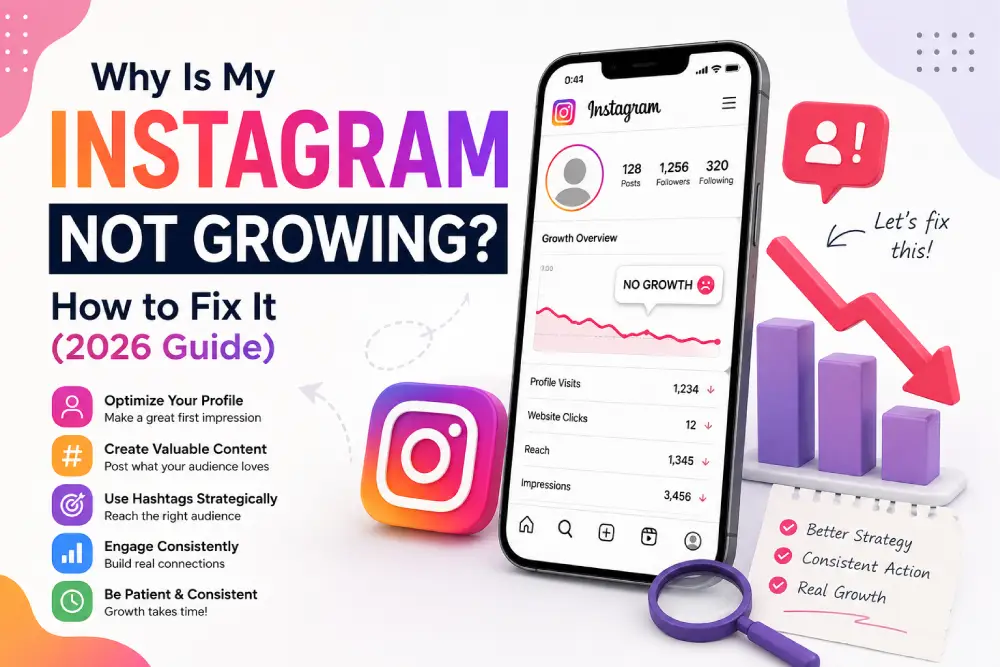
If you've been posting on Instagram for months and your follower count barely moves, you're not alone. Millions of creators and small businesses face the same wall. The good news is that Instagram growth is not luck. It follows patterns, and once you know what's holding you back, you can fix it step by step.
Let's be honest. You post regularly. You use trending audio. You even follow the "best time to post" advice from every blog you've read. Yet your likes stay flat, your followers barely increase, and your reach feels like it's shrinking every week.
This is one of the most common frustrations on social media today, and it happens to accounts of every size, from brand-new pages to accounts with a few thousand followers. Some people even see their views go up while their follower count stays completely flat, which feels even more confusing.
The truth is, Instagram growth depends on a mix of factors working together: your content, your consistency, your engagement, and how well Instagram's algorithm understands what your account is about. It's rarely just one thing. It's usually a small combination of habits that, once fixed, start turning things around within a few weeks.
In this guide, we'll break down the real reasons your Instagram isn't growing, and give you practical, easy-to-follow fixes for each one. No fluff, no empty promises, and no expensive tools required. Just what actually works, explained in plain, simple language.
One of the biggest reasons accounts stop growing is a lack of focus. If your page posts travel photos one day, memes the next, and personal selfies after that, people don't know what to expect from you. Confused visitors rarely hit the follow button, even if they enjoyed the one post that brought them to your profile.
Instagram's algorithm also struggles to understand mixed content. It cannot tell who to show your posts to because it does not know what your account is actually about. When your content is scattered across many unrelated topics, Instagram ends up showing your posts to a broader, less interested audience, which lowers your overall engagement rate.
Think of your Instagram page the way you'd think of a shop. If a shop sells shoes, books, and vegetables all in one messy aisle, customers get confused and leave. But a shop that clearly sells one type of product builds a loyal customer base that keeps coming back.
People don't follow accounts just to see pretty pictures. They follow accounts that entertain them, teach them something, or make their life a little easier. If your posts don't do at least one of these three things, viewers scroll past without a second thought, even if the photo or video itself looks great.
This is why a simple, slightly rough tutorial video often performs better than a beautifully edited but purposeless post. Value beats polish almost every single time on Instagram.
Instagram has made it clear that Reels get more reach than regular photo posts right now. If your content strategy is still built around static images only, you are missing out on the platform's biggest traffic source. Instagram's own team has repeatedly said that video content, especially Reels, is prioritized in the Explore page and recommended content sections.
This doesn't mean photo posts are useless. Many accounts still grow with a mix of carousels and Reels. But if Reels make up zero percent of your content, you're leaving a huge growth opportunity untouched.
Instagram tests every new post with a small group of your followers first. If that post gets strong engagement quickly through likes, comments, shares, and saves, Instagram pushes it to more people. If engagement is weak in that first hour, the algorithm assumes your content isn't worth spreading and quietly limits its reach.
This is why posting more often doesn't automatically fix low growth. If every post gets weak early engagement, posting five times a day just multiplies the problem instead of solving it. Quality signals in that first hour matter far more than raw posting frequency.
Instagram is a two-way platform. If you only post and never interact with other accounts or your own followers, you are missing a major growth lever. Genuine engagement, such as commenting, replying, and connecting with people in your niche, builds real relationships that turn into follows and shares.
Sometimes the problem isn't your content at all. It's what happens when someone new lands on your profile. If your bio is unclear, your profile photo is low quality, or your grid looks messy, visitors leave without following.
Hashtags still help people discover your content, but using overly generic or overly competitive hashtags means your posts get buried in seconds. Hashtag stuffing, meaning using 20 to 30 unrelated tags, can also make your account look spammy.
Posting once and then disappearing for two weeks tells the algorithm, and your audience, that your account isn't active. Consistency doesn't mean posting five times a day. It means showing up on a schedule your audience can rely on, even if that's just three times a week.
Inconsistent posting also makes it harder to learn from your data. If you post randomly, you can't tell whether a slow week happened because of your content or simply because you went quiet. A steady rhythm gives you cleaner insights to work with.
It's easy to get discouraged when you compare your page to accounts that have been posting for years. But growth isn't linear, and most successful accounts had months, sometimes years, of slow growth before things picked up. Comparing your day 30 to someone else's day 1000 will only frustrate you unnecessarily.
Before you post your next piece of content, run through this quick list:
If you can check most of these boxes, you're already ahead of most accounts that struggle to grow.
Instagram growth isn't about chasing one trick or hack. It's a mix of clear positioning, valuable content, genuine engagement, and consistency over time. Most accounts that feel "stuck" are usually missing just one or two of these pieces, not all of them.
Start by picking the one issue from this list that sounds most like your situation, fix that first, and then move on to the next. Small, steady improvements add up to real growth over time. Don't try to fix everything at once. Pick one change, apply it for two to three weeks, and watch how your numbers respond before moving to the next fix.
Growth takes patience, but it is absolutely possible for any account willing to put in consistent, focused effort. The accounts that grow steadily aren't always the most talented or the most well-funded. They're usually just the ones that stuck with the basics long enough to see them work.