
Techstreat Solutions

Please fill out the form below if you have a plan or project in mind that you'd like to share with us.
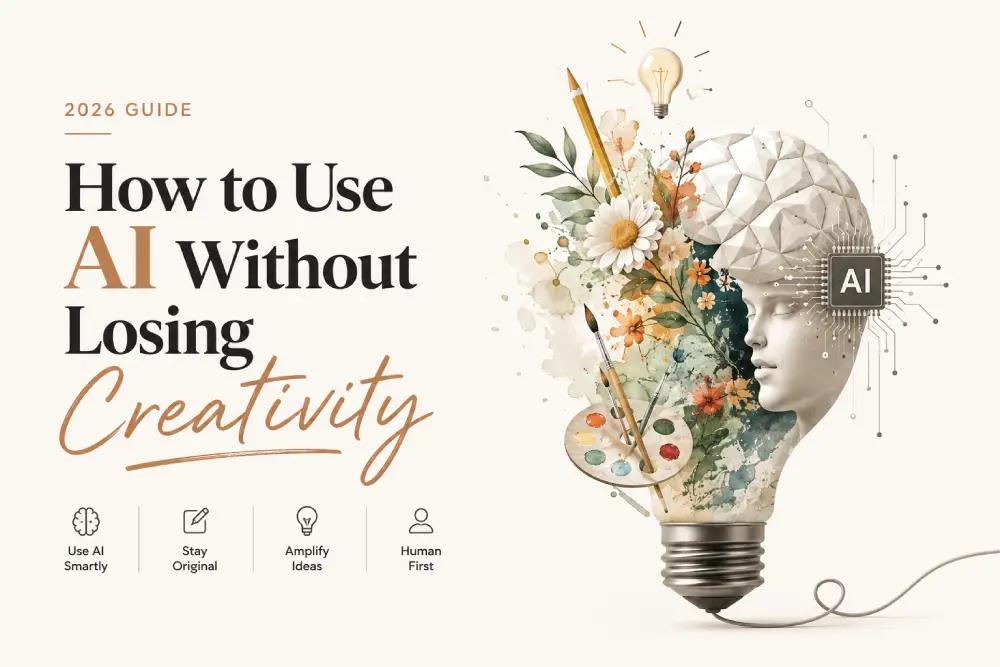
A practical guide for teams that want the speed of AI and the originality of human thinking.
How to use AI without losing creativity is one of the biggest questions facing writers, designers, marketers, and business owners today. AI tools can now write a blog post or design a social media graphic in seconds. But this speed brings a common worry: will using AI tools for creative work make my content feel less original?
Using AI without losing creativity is possible, and it has a simple answer: use it the right way, not just more of it. In this blog, we look at the real advantages and disadvantages of AI in creative work, show two simple charts to explain the balance, and share seven practical habits that keep your ideas fresh and human, even when AI is helping you.
Losing creativity to AI usually means one of these three things:
None of this happens because AI is a bad tool. It happens when AI is used as a replacement for thinking, instead of as support for thinking. The tool is not the real problem. How a person uses the tool is what makes the difference.
AI tools for creative work offer real, practical benefits, which is why more companies use them every year:
For a technology company, these benefits matter a lot. Marketing teams, product teams, and content teams can all move faster when they know how to use AI tools for creative work the smart way.
The advantages and disadvantages of using AI in creative work both deserve a fair look before you build AI into your daily workflow. Here is an honest look at both sides:
| Advantages of Using AI | Disadvantages of Using AI |
| Saves time on research and first drafts | Can sound generic if you don't edit it |
| Helps beat writer's block with quick ideas | May reduce original thinking if overused |
| Improves consistency across large volumes of content | Can repeat common ideas instead of fresh ones |
| Makes editing and proofreading faster | Sometimes gets facts wrong, so it needs checking |
| Supports SEO with keyword and structure ideas | Can weaken your personal or brand voice over time |
| Lowers the overall cost of content production | Cannot fully understand emotion the way humans do |
AI helps most with research, first drafts, and editing, but it is not equally strong at every part of creative work. The chart below shows a simple way to think about this:
Figure 1: AI gives the most help with research, first drafts, and editing. Human judgment still leads on final decisions, storytelling voice, and emotional connection.
This is why writers, designers, and marketers who use AI well still spend real time on the final read-through. They let AI handle the heavy lifting early on, then step in for the parts that need a human touch.
AI only, human only, and a balanced approach each produce very different results, as the chart below shows.
Figure 2: A balanced approach keeps most of the speed and consistency of AI while holding on to the original thinking and emotional depth that come from human creativity.
As the chart shows, an AI-only approach is fast but weak on original thinking and emotional depth. A human-only approach protects originality but is slower and harder to scale. A balanced approach gets you most of the best of both. This is the goal to aim for.
Practical ways to use AI without losing creativity start with these seven habits:
Common mistakes when using AI for creative work usually come from the same root cause: treating AI as the decision-maker instead of the assistant.
Once you fix that mindset, most of these problems disappear on their own.
Finding the right balance between AI and human creativity starts with a simple rule: the 80/20 approach. Let AI handle about 80 percent of the repetitive, time-consuming work, such as research, outlines, and first drafts. Keep the final 20 percent for yourself: the voice, the judgment calls, the personal stories, and the emotional tone. That last 20 percent is usually what makes content memorable, and it is the part only a human can truly own.
Think of AI as a helpful assistant sitting next to you, not a replacement sitting in your chair. Used this way, AI does not take away your creativity. It gives you more time and energy to focus on the ideas that only you can bring to the table.
Learning how to use AI without losing creativity, not avoiding AI altogether, is the real skill for the coming years. AI tools for creative work are not going away, and there is no need to fear them. Teams that master this balance will produce content faster, rank better in search results, and still sound genuinely human.
At Techstreat, we believe the best content comes from pairing smart AI tools with real human thinking. Start small: pick one task this week, let AI help with the first draft, and finish it in your own voice. That one habit is often enough to keep your creativity strong while AI does the heavy lifting.